OVERVIEW
APPLICATIONS
INTERACTIVE APPLETS
HISTORY OF THE METHODS/FLOW CHART
PUBLICATIONS
EDUCATIONAL MATERIAL
ACKNOWLEDGEMENTS >br>
ABOUT THE AUTHOR/CV
Copyright:
1996, 1999, 2006
J.A. Sethian
Level Set Methods for Multiple Interfaces
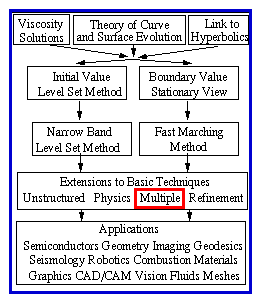
Click on navigable flow chart to go to new topic
Click on navigable flow chart to go to new topic
In order to consider more than one pair of materials, the natural idea is to employ more than one level set function. In other words, given three regions A, B, and C, one might employ three different level set functions, each representing a signed distance function and chosen as negative inside the appropriate region and positive outside. Various approaches are considered in the references below.
New Book and Resource on Level Set and Fast Marching Methods
References:
-
Motion of Multiple Junctions:
A Level Set Approach
: Merriman, B., Bence, J., and Osher, S.J.,
Jour. Comp. Phys., 112, 2, pp. 334-363, 1994
-
A Variational Level Set Approach to Multiphase Motion
:
Zhao, H-K., Chan, T., Merriman, B., and Osher, S.,
Journal of Computational Physics, 127, pp. 179--195, (1996).
-
Level Set Techniques for Tracking Interfaces; Fast
Algorithms, Multiple Regions, Grid Generation, and
Shape/Character Recognition
: Sethian, J.A.,
Proceedings of the International Conference on Curvature Flows and Related
Topics,
Trento, Italy, 1994, Eds. A. Damlamian, J. Spruck, and A. Visintin, Gakuto
Intern. Series, Tokyo, Japan, 5, pp. 215--231, 1995.
Abstract
We describe new applications of the level set approach for following the evolution of complex interfaces. This approach is based on solving an initial value partial differential equation for a propagating level set function, using techniques borrowed from hyperbolic conservation laws. Topological changes, corner and cusp development, and accurate determination of geometric properties such as curvature and normal direction are naturally obtained in this setting. In this paper, we review some recent work, including fast level set methods, extensions to multiple fluid interfaces, generation of complex interior and exterior body-fitted grids, and applications to problems in shape and character recognition.
Download publications
-
Algorithms for Tracking Interfaces in CFD and Material Science
: Sethian, J.A.,
Annual Review of Computational Fluid Mechanics, 1995.
Abstract
We describe new applications of the level set approach for following the evolution of complex interfaces. This approach is based on solving an initial value partial differential equation for a propagating level set function, using techniques borrowed from hyperbolic conservation laws. Topological changes, corner and cusp development, and accurate determination of geometric properties such as curvature and normal direction are naturally obtained in this setting. In this paper, we review some recent work, including fast level set methods, extensions to multiple fluid interfaces, generation of complex interior and exterior body-fitted grids, and applications to problems in combustion and material science.
Download publications
-
A Level Set Approach to a Unified Model for Etching, Depo
sition,
and Lithography III:
Re-Deposition, Re-Emission, Surface Diffusion, and Complex
Simulations
: Adalsteinsson, D., and Sethian, J.A.,
Journal of Computational Physics, 138, 1, pp. 193-223, 1997.
Abstract
Previously, Adalsteinsson and Sethian have applied the level set formulation to the problem of surface advancement in two and three-dimensional topography simulation of deposition, etching, and lithography processes in integrated circuit fabrication. The level set formulation is based on solving a Hamilton-Jacobi type equation for a propagating level set function, using techniques borrowed from hyperbolic conservation laws. Topological changes, corner and cusp development, and accurate determination of geometric properties such as curvature and normal direction are naturally obtained in this setting. Part I presented the basic equations and algorithms for two dimensional simulations, including the effects of isotropic and uni-directional deposition and etching, visibility, reflection, and material dependent etch/deposition rates. Part II focused on the extension to three dimensions. This paper completes the series, and add the effects of re-deposition, re-emission, and surface diffusion. This requires the solution of the transport equations for arbitrary geometries, and leads to simulations that contain multiple simultaneous competing effects of visibility, directional and source flux functions, complex sputter yield flux functions, wide ranges of sticking coefficients for the re-emission and re-deposition functions, multi-layered fronts and thin film layers.
Download publications
-
Tracking the Evolution of Multiple Interfaces and
Multi-Junctions
: Sethian, J.A.,
CPAM Report and LBL Dept. of Mathematics, 1996.
Abstract
We design and implement a general algorithm for following the evolution of multiple interfaces and multiple junctions in two and three space dimensions. The core of the technique rests on a level set algorithm for following an interfaces between two regions. This level set formulation is based on solving a Hamilton-Jacobi type equation for a propagating level set function, using techniques borrowed from hyperbolic conservation laws. Topological changes, corner and cusp development, and accurate determination of geometric properties such as curvature and normal direction are naturally obtained in this setting. In this paper, we extend these techniques to an arbitrary number of interfaces in two and three space dimensions, which may intersect in multiple junctions, such as triple points.
Download publications