-
The theory and analysis of curve and surface evolution
,
which analyzes interfaces stability,
the development of corners, shocks, and entropy conditions
in interface motion, and the smoothing role of curvature providing
the viscous limit for interface motion.
- Exploiting numerical schemes for hyperbolic conservation laws and using them to track interfaces; providing schemes which correctly capture corners and curvature effects.
for current work on
Fast Marching Methods and Level Set Methods.
|
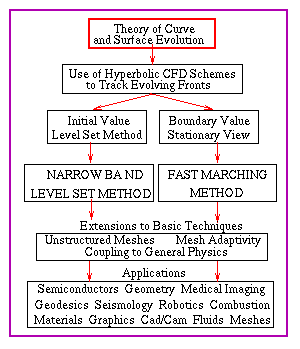
The flow chart on the left is a clickable map. Position the mouse over any line of text and click. This will direct you to that topic. When you click on line of text, this will send you to the new page with that topic outlined in red. The flow map on each of the other pages are also clickable. |
|
The flow chart on the right gives the evolution modern techniques for interface propagation. The main ideas are in the first two boxes: these lead to both Level Set Methods and Fast Marching Methods. The most natural place to start is in the top in red. |
J.A. Sethian
sethian@math.berkeley.edu