


A constrained optimization problem is a problem of the form
maximize (or minimize) the function  subject
to the condition
subject
to the condition  .
.
In some cases one can solve for  as a function of
  and
then find the extrema of a one variable function.
and
then find the extrema of a one variable function.
That is, if the equation is equivalent to  ,
then we may set
,
then we may set
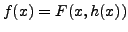 and then find the values
  for which
  achieves an extremum. The extrema of
  are
at
are
at  .
.
Find the extrema of
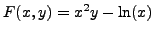 subject to
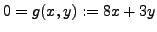 .
.
We solve
 . Set
. Set
 .
Differentiating we have
.
Differentiating we have
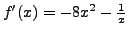 .
Setting
.
Setting  , we must solve
 , or
, or
 . Differentiating again,
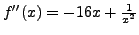 so that
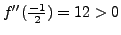 which shows that
 is a relative minimum of and
 is a relative minimum of
subject to .
is a relative minimum of
subject to .
Find the extrema of
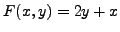 subject to
 .
.
Using the quadratic formula, we find
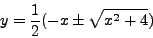
Substituting the above expression for in we
must find the extrema of
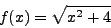
and
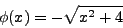
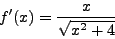
and
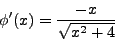
Setting (respectively,  ) we find
 in each case. So the potential extrema are
 and
and  .
.
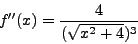
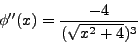
Evaluating at , we see that  so that is a
relative minimum and as
so that is a
relative minimum and as  , is a relative maximum.
(even though
, is a relative maximum.
(even though
 !)
!)
If is a (sufficiently smooth) function in two
variables and  is another function in two variables,
and we define
is another function in two variables,
and we define
 , and
, and
 is a relative extremum of subject to , then
there is some value
is a relative extremum of subject to , then
there is some value  such that
 .
.
Find the extrema of the function
subject to the constraint
.
Set
 . Then
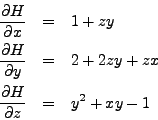
Setting these equal to zero, we see from the third equation
that  , and from the first equation that
 , so that from the second equation
 implying that . From the third equation, we obtain
  .
.
Find the potential extrema of
the function
 subject
to the constraint that
subject
to the constraint that
 .
.
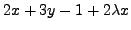
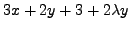
 . Then
 |
 |
 |
(1) |
 |
|
 |
(2) |
 |
|
 |
(3) |
Multiplying the first line by and the second by we obtain:
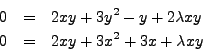
Subtracting, we have

As
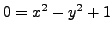 , we conclude that
  . Substituting,
we have
. Substituting,
we have
 .
.
So the potential extrema are at or
 .
.